Prescription for Play: How Pediatric Play Promotes Health and Healing

I was honored and so excited to be interviewed by Photographer & Guest Writer, Marj Kleinman for her article at TocaBoca.com. She and I have much in common, including a deep passion for child life and play in hospitals, and the fact that we are both alums from Saint Ann’s School in Brooklyn, NY. She is a talented artist and used her creativity to write a photo journal of child life and play at Maimonides Hospital. I will publish that here next week. The Toca Boca article is reprinted here in full below.

Child life specialists support kids and families in a hospital environment, reducing stress and increasing joy.

Marj Kleinman
BY
Marj Kleinman, Toca Magazine Guest Writer

When I tell someone that I volunteer in pediatric hospitals, I usually spot a sad face across from me. That response is understandable, given that hospitals can be scary and sometimes painful and upsetting. But in fact, there’s no greater place to see joy and resilience on display, all through kids’ natural passion for play.

Whether at their doctor’s office or in the ER, kids find a way to play, particularly with encouragement. Most children’s hospitals today come equipped with a playroom and a bevy of materials and activities, so kids can be kids while hospitalized. Once they see a playroom full of toys, messy finger paints and a silly guy blowing bubbles, they know this place is made for them and they will probably feel safe there. There’s even a team of people whose job is to play with your child: the child life specialists. They become parents’ partners in health and healing.

Meet the child life team: Your play partners

Many parents are surprised to learn that there’s a person solely focused on your child’s emotional health during a hospital stay — and they do it mainly through play. Child life specialists (CLSs) help kids and families adapt to the hospital environment and support them in understanding what’s taking place, thereby reducing the stress of a hospitalization. CLSs are trained in child development and play theory, as well anatomy, research methodology, sociocultural issues, ethics, family systems and bereavement, among other things. They also act as a bridge and advocate with your medical team. Child life departments often include art and music therapists, and are visited by yoga and mindfulness teachers, clowns and other practitioners.

Language of play

Play is the universal language of childhood — in fact, when CLSs assess their patients, they’re watching how kids communicate via play. I spoke to Deborah B. Vilas, a CLS and social worker who teaches child life graduate students at Bank Street College of Education. Vilas says, “Young children won’t sit down and say, ‘I felt sad today and I think I’m anxious about the medical treatment I’m getting.’ When children are playing, they act out scenarios and show us what they’re feeling; they show us what they understand, what they’re capable of and what their coping mechanisms are.” This may seem obvious, but in some hospitals, there’s a misconception that play is frivolous or low on the priority totem pole.

Young children won’t sit down and say, ‘I felt sad today and I think I’m anxious about the medical treatment I’m getting.’

Vilas reminds us, “It’s been proven that when children have play opportunities that they need less medicine, less anesthesia, are more compliant and get better faster. The benefits of play reach beyond the child to assist medical personnel and influence the hospital’s bottom line.”

Benefits of play

According to the American Academy of Pediatrics (AAP), “Play is essential to development because it contributes to the cognitive, physical, social, and emotional well-being of children and youth. Play also offers an ideal opportunity for parents to engage fully with their children.” Why would all that stop at the hospital? The AAP goes on to state that hospital play is a necessity that helps kids cope with treatment and stay on track, developmentally. The uses and benefits of play in medical settings are varied and significant.

At its essence, play provides a safe space for kids to experiment with unfamiliar and often scary experiences. Through open-ended play, kids can take in new information at their own pace, re-create situations and play out fears until they are familiar enough to gain a sense of mastery over the situation. When supported by an empathetic parent or CLS, this process is deepened and they can better process and release feelings.

At its essence, play provides a safe space for kids to experiment with unfamiliar and often scary experiences.

Open-ended and child-centered play, in particular, are highly beneficial, as they provide opportunities for kids to immerse themselves more deeply in play and lead from a sense of agency. Unfortunately, free play has been on the decline due to our hurried and jam-packed, overscheduled and tech-filled lifestyles, yet it is necessary for skill development, self-regulation, independent thinking and creative problem solving. In the hospital, where kids lack choices, it’s even more crucial to let kids be in charge.

Medical play

One of the roles of the CLS is to normalize the hospital experience through play. They might do familiarization activities, for example, building a robot using a bedpan, tongue depressors and IV tubing, all taped together with bandages. Suddenly medical supplies aren’t scary, cold, weird objects that only doctors and nurses use, and kids can “hack” the hospital.

Going a step further, medical play with a toy doctor’s kit and/or real medical supplies can 1.) educate children about an upcoming procedure, 2.) let them process their experience, before, during or after a procedure, and 3.) put the child back in the driver’s seat.

hospital_play_meghan_2

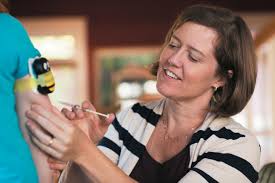
Meghan Amorosa, CLS, engages Jan, age 4, in medical play at Brooklyn Hospital Center, Brooklyn, N.Y. Photo by Marj Kleinman.
 

Children experience a strong sense of helplessness, vulnerability and anxiety when faced with uncertainty and misconceptions (let’s face it, so do grownups). Procedural support helps educate, greatly reducing feelings of unpredictability, and increases a level of mastery.

Meghan Amorosa, child life specialist at Brooklyn Hospital Center in Brooklyn, N.Y., says, “A really big part of medical play is about giving patients choice and control over their own hospital experience. Instead of being the patient, they become the doctor and play on their own little patient.” She observed that Jan (pictured above) gave the doll a lot of shots, which is typical in patients who’ve been poked a lot. In fact, “If a kid gives a doll a million shots, they’re showing you how painful that was for him,” says Vilas.

A really big part of medical play is about giving patients choice and control over their own hospital experience.

Movement plays a key role in healing.

Movement also plays a key role in healing, which is why doctors want patients up and walking almost right after surgery. If kids can get out of bed and step on bubble wrap or a floor piano, ride a hospital wagon around the unit, or skate down the hallway on their IV pole, they get the blood circulating, feel more energized and also empowered at the same time.

Play is powerful and can be tailored towards your child’s individual age, temperament and tastes. Read on to find out 10 ways to support kids going to the hospital, as patients or visitors.

Marj Kleinman is a Brooklyn based photographer and children’s media producer with a master’s in educational psychology.
Playing for Good: Touch-Tables in Hospitals


umass-childrens-medical-center-4

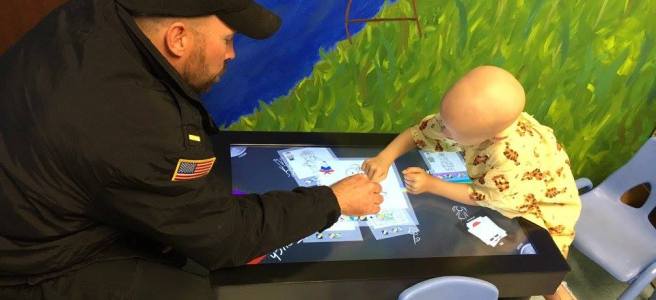
Interview with guest Tom Bannon, Vice President, AFTER-MOUSE.COM on PLAY for Good, an initiative of AFTER-MOUSE.COM Twitter: @AFTER_MOUSE. I “met” Tom through an email when he read this blog and reached out to me. I think that his products are a great match for Child Life in Hospitals, so I offered to spotlight him on this blog. So, Heeeeeeeeeere’s Tom!

Tell us a little about who you are.

tom-pic-2a

I have been working in the technology and software licensing space for over 20 years. My career is about helping partners and customers make technology work for their business and their customers. Through my work, I have seen how technology can be transformative – making an experience more enjoyable for or helping connect people when communication barriers seemed impenetrable, among so many other benefits. I believe in my work, because I believe there is a lot of positive potential when technology is used for good.

What is AFTER-MOUSE.COM? How did you get involved with them?

AFTER-MOUSE.COM is a fast-growing industry leader in multi-touch technology applications. I joined five years ago to lead the U.S. sales team and be a part of business at the cutting-edge of multi-user collaborative technology.

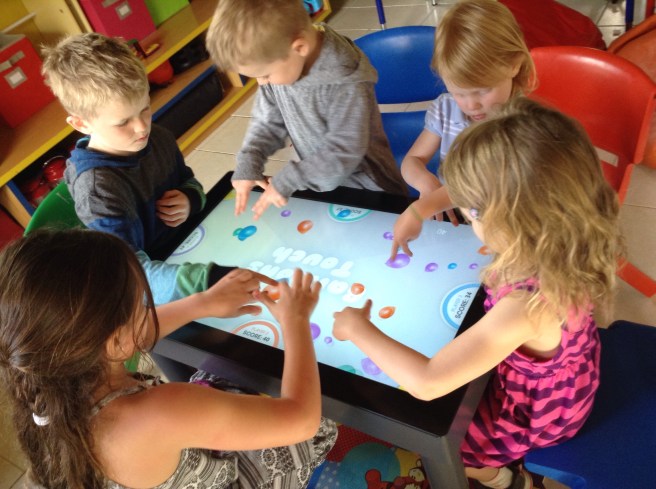
We work with retail, real estate, automotive, financial, education, healthcare and other industries to provide unique customer experiences through interactive and collaborative touch-table applications. With more than 180 custom applications and 20 multi-touch, multi-player games for all age groups, our PLAY touch-table brings customers, families and colleagues together to experience truly collaborative activities. Whether it is in a waiting room or at a resort, our PLAY table delivers an experience that builds community and pure fun. Check out this video of guest using the PLAY table in a Novotel lobby: https://www.youtube.com/watch?v=40OniciXvDA

How did you get involved with Hospitals?

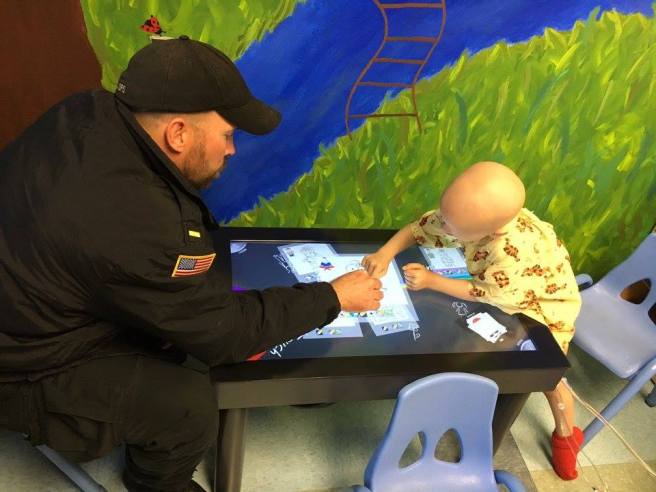
AFTER-MOUSE.COM has worked with hospitals and medical centers for more than 5 years. We have PLAY touch-tables in pediatric departments, waiting rooms and child life centers throughout the U.S. This is an important partnership for us as we work to promote the empowering and healing benefits of collaborative, playful learning.

Sometimes a hospital can be a scary and uncomfortable place for a child. Promoting collaborative, playful learning in these environments can provide positive emotional experiences and healing to help children cope.

dreams-los-cabos-1

What are the benefits in your eyes of these interactive games? Any downsides?

The positive benefits of technology-based collaborative play inspired us to launch PLAY for Good, an AFTER-MOUSE.COM initiative working with partners to place multi-player touch-tables in nonprofit children’s hospitals and youth centers. The PLAY for Good team helps connect funders and donors with nonprofit hospitals and children’s health organizations that can use PLAY tables to promote collaborative play through our educational, multi-player children’s games.

Today, 91% of children between the ages of 2 and 17 play technology-based games. Despite the rapid uptake of technology, there is still little guidance on how to effectively harness technology as a tool for improving learning through play. Most guidance for children’s interaction with technology is based on “screen time,” the amount of time a child should spend looking at a digital screen. However, technology has progressed beyond the linear, sedentary relationship between child and screen, frequently thought of as watching television.

Technology-based play is not restricted to single user, sedentary experiences; rather technology can facilitate highly interactive and collaborative play activities that enable peer-to-peer learning. Unlike adult-child interactions, peer-to-peer learning allows for a balanced power dynamic which helps children refine planning, negotiation, and cooperation skills.

In a hospital environment, technology-based games can help a child cope with a stressful or uncomfortable situation. Children grappling with chemotherapy-related nausea or preoperative anxiety, for example, have had success playing technology-based games to help with emotional management.

What are your hopes for this product?

Our PLAY touch-table and children’s game bundle can provide entertainment to children in waiting rooms and lobbies – but they can also promote cognitive development, improves quality of life and can help a child manage emotional stress, when used appropriately.

In a world where technology is increasingly integrated into the way we live, we want to help promote the positive benefits it can yield. Interactive, technology-based collaborative, playful learning has changed the nature of children’s relationship with a device. When used appropriately, interactive technology can provide positive elements to children’s play and learning by facilitating exploration and experimentation in a dynamic digital multi-player experience.

What would you like Child Life Specialists to know about Play touch-tables?

We want to work together. While the body of research on the impact of technology-based play on child development is still in early stages, there is research confirming that, when used appropriately, interactive technology can be a valuable tool in promoting playful learning. PLAY touch-tables, when added to existing Child Life programs, have enhance a child’s experience in the hospital. Our PLAY for Good team understands the resources constraints of nonprofit organizations, so they can help identify funding opportunities with your development team and provide guidance on how the PLAY touch-table can be leveraged to support on-going fundraising goals through sponsorship programs.

Play for Good Program PDF

Tell us a bit about your international work.

We have worked with many companies around the world through our offices and partners in the US, Europe, Dubai and many other regions as well. We have now delivered projects in over 40 countries.  We continue to expand into new markets with our products.


Building Bridges Instead of Walls – Teaching & Learning in Mexico City


sonreir


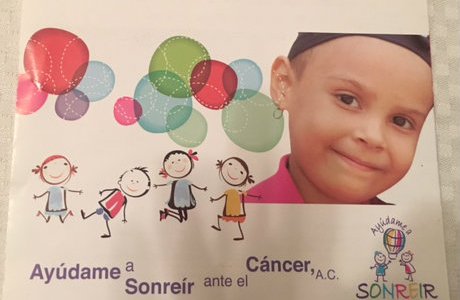
One week post-election, I found myself bound for Mexico City, ready to teach and learn alongside my adventure colleague, Maria Busqueta. Marifer, (as I call her) hosted me in her home town, where she is a child life specialist, psychologist and educator. It was a whirlwind couple of days, as we visited the General de la Raza Hospital, learned about the Ayudarme a Sonreir ante el Cancer Foundation, The Vuela Foundation, taught a class on play techniques for adolescents, and attended a two-day conference on palliative care. Phew!

My first impressions of Mexico City and Marifer’s neighborhood: Unexpectedly cold and wet. Lovely hills rising up from the urban center. Cypress trees in plenty and Bougainvillea in bright, fuscea explosions amongst the trees and spilling down high stone retaining walls. Hilly, winding roads with speed bumps everywhere instead of stop signs. Heavy and erratic traffic. Cold mornings and nights. Marifer’s house has many levels to it, all encased in gingerbread auburn ceramic tiles. Like my home, the kitchen and living room are on the upper level, with bedrooms below. Marifer’s jaunty beagle, Duncan, lords over the front yard and threatens escape with each coming and going of a human being through the iron gate. Marifer’s mother cooks for us several times a day, filling me with homestyle Mexican fare. It is mere moments before I feel like family.

We are up bright and early my first full day there, ready to pay a visit to the Hospital Raza. Lisette Garcia Urenda, the founder of the Ayudarme a Sonreir ante el Cancer Foundation (which translates as “We help you smile after cancer”), is hosting us, and we meet her outside of the largest and oldest public hospital in all of Mexico. The sidewalks surrounding the building team with merchants hawking their wares, everything from pork roasting in a cauldron to magazines and fruit. We weave past the stalls and in through the back emergency entrance to the hospital. As we enter the foyer, several pediatric cancer patients and their families are exiting the hospital, bundled up for discharge and eager to be home. But they stop to hug, kiss and chat with Lisette. They shake our hands and offer “mucho gusto” as Lisette introduces us.

It is clear that the children and their caregivers adore Lisette. And it is easy to see why – she is all brightness, high energy and love. One teenage boy jokes for me to take him back to the United States with him. The younger children glance at us shyly.

cimg1024

There are three events planned for the day, two presentations to patients and a therapeutic art activity to be conducted on the inpatient ward. The foundation grants wishes for pediatric cancer patients, and families have gathered to witness Lisette’s presentation of a wish to a young girl. They sit in tiny, child-sized plastic chairs around the parameter of an open roofed waiting area. The children sport face masks, bald heads, hats, and winter coats with good reason. It is cold.

The child is brought to the center of the room, and Lisette introduces her to everyone. I am regretting in the moment that I don’t understood more Spanish, but it seems that she is telling them how well the girl is doing post bone marrow transplant. With great flourish, Lisette hands the girl a large present. The child opens it with excitement and beams at its contents, an “alien” doll that  is apparently quite the rage. It’s hard not to note what a child with cancer might have in common with the toy. Both are bald; both might need to be isolated because of threatening germs in a hostile environment; both may need to be fed through a tube in the stomach. And, any child who has such a diagnosis may often feel like a misunderstood species hovering over the more typical lives of healthy peers.

The child hugs Lisette. The onlookers clap, and I wonder if they are envious of her.  Lisette explains to me that most of them will have a wish granted at some point, so that no child feels left out. Later, the child’s mother is crying in the hallway, sharing bad news with her social worker. Her daughter has relapsed. The bone marrow transplant didn’t take.

Lisette says that many of these children die, and that in order to do her work, she must get lots of therapy and continually study and obtain higher degrees. This is why she is a current student of Marifer’s. She does the work because when her father-in-law died, he told her that she must work for the forgotten children. She says that many of these children don’t have electricity in their homes.

The next planned event is the presentation of a natural hair wig made from five individual donations of hair. The recipient is a six-year-old girl. She is very shy and quiet. We are in a hall outside of the infusion clinic. The floors are buckled and seams of cement overflow the protruding tile. I wonder if this is from an earthquake. Nurses wear white and institutional green uniforms, donning plastic nursing caps in the same colors. I feel like I have stepped back into the 1950’s, except for the fact that they are all taking photos on their cell phones as Lisette presents the wig to the child.

Lisette speaks with the girl for quite some time. She reassures her that she needn’t speak if she doesn’t wish to, that they can communicate with their eyes. Lisette tells the child about the beauty of her heart, that the wig is just an accessory, that her beauty is not dependent on whether or not she has hair.

You must say to yourself every day in the mirror: “I am beautiful!”

The child tries on the wig and looks in a mirror provided by Lisette. Everyone poses for photos with her. In the end, her mother repacks the wig carefully in the box, and they are on their way.

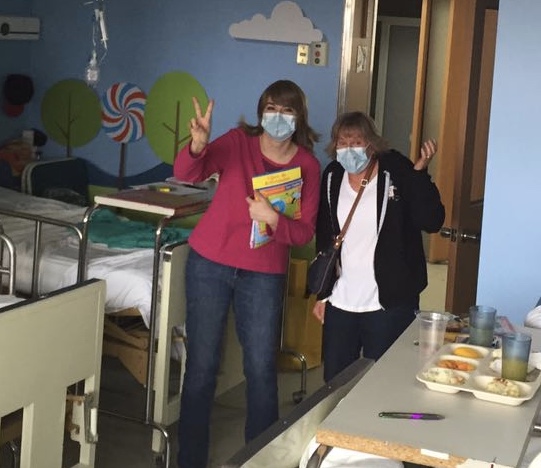
Lisette leads us through a chaotic and crowded hallway to a packed elevator that carries us to the inpatient  pediatric oncology unit. In the hallway between two separate wings (one designated for solid tumors, the other for liquid), is a small but well equipped playroom. Siblings and patients mingle at child-sized tables. There are floor to ceiling shelves laden with cause and effect toys, a toy hospital, dollhouse, action figures (“for boys” says the playroom coordinator), blocks, puzzles, games and art materials. There is a large dollhouse in a corner, a kitchen play set, and several large bookcases overflowing with books. Lisette’s foundation supplies the  DVD lending library. One child sits with an adult working on a puzzle. Another plays with the dollhouse. A mothers group meets in the waiting room next door. The only thing I feel is missing is a medical play corner and sensory play materials. A flatscreen tv plays a Disney movie overhead.

Lisette has plans for an expressive arts activity. She brings us to the liquid tumor wing, into a room with six beds. Five children between the ages of two and fourteen seem excited to see Lissette and very open to our visit. The six-year-old boy is talkative and funny. After some quipping back and forth, Lisette hands out crayons and art paper to the children with a body outline on it.  But before she can begin to explain the instructions, the two year-old’s mother leaves the room, and the toddler begins to cry loudly and  inconsolably . She sits in her cage-like crib, crying desperately, reaching both arms up as if asking her absent mother to pick her up. Either that, or she is imploring the Gods to bring her mother back!

Lisette approaches with kind words, but the toddler is having none of it. She screams louder. Lisette offers her crayons and a “Frozen” coloring book. The child cries “No!” and turns away. Lisette is unperturbed. Using the surroundings, she jumps quickly into a bit of improv. The room has been newly decorated with a brightly colored mural on all four walls, ceiling to floor. It is a nature and farm scene. Near the girl’s bed, close to the floor, a mother duck swims with her three ducklings on a bright blue pond. Lisette launches into a conversation with the ducklings, turning her back on the toddler, lessening the child’s stranger anxiety by ceasing direct eye contact. She engages everyone in the room in asking the names of the ducks. She suggests the proffered names, and the little girl shakes her head in protest at each one. But she has stopped wailing and is watching Lissette intently. Lisette blocks the child’s view of the mother duck and tells a tale of the ducklings searching for their mother. She reassures the girl that her mommy will always return. We all sing the song “Five Little Ducks”. Lisette offers the coloring book again, asking, “May I put it on your bed?” The child accepts and begins to color.

imgres-6

Lisette conducts the art activity with success. She speaks to the children about the variety of emotions we all have. She says they will play a coloring game based on a game called “Basta!” (enough). She takes turns calling out emotions, and each time they must grab a crayon and color within the body outline to represent where and how much of that emotion they have until Lisette yells, “Basta!” Lisette is very lively and whips the kids up into a coloring frenzy. She begins with the emotions of fear, anger, and sadness, and ends with love and joy. I am sitting with the toddler, who is methodically drawing many tiny, blue circles on each page of her coloring book, while she listens and glances at the other children. She watches closely as a nurse enters the room and approaches the six-year-old. The boy grins and says, “It’s good that you are here. My IV is backing up.” The nurse adjusts his IV, then moves over to the toddler, preparing medicine in a syringe without a needle. The toddler opens her mouth complacently to receive it without complaint.

The fourteen-year-old has gone for a walk. I had noticed when I entered the room that she didn’t appear physically ill. She has all of her hair, and is not connected to an IV. She wore a contented, cheerful expression while she chatted on her cell phone. Soon, it is time for us to move on. The teen has returned to her bed. We all pose for photos. All the children except the toddler smile. She still appears a bit somber.  I am the first to leave the room, and the teen’s caregiver follows me and grabs my arm in the hallway. She asks if I understand Spanish and begins to pour out a story to me that even with my broken Spanish, I can piece together. She is not the teen’s mother, but her aunt.

Two weeks prior, she, her two sisters and family members were traveling by car in a caravan. There was a horrible crash. The teen’s mother and father were killed. Her brother lies in critical condition in the ICU. Although the teen was unharmed, the tests she underwent at the hospital revealed that she has cancer. She had only just learned of her parents’ deaths the day before. I struggle to match that news with the image of the calm, smiling teen I’d met. Was she in shock? Denial? Is it her Faith in action?

The aunt shows me photos on her phone of her family, as well as a video about a teen whose mother dies. She says she is a Jehovah’s Witness and believes that we will all see our loved ones again after death. I tell her that I will carry her family in my heart.  I think about how much good healthcare in hospitals involves helping patients and families to tell their stories. This seems true in every country I visit. And in every country thus far, families don’t hesitate to share their stories with a stranger. Perhaps it is easier to tell a stranger. But it is more than that. This woman, and others I have met, seem compelled to share their narratives, as if we couldn’t stop them if we tried.

Leaving the hospital, I am sad, exhausted and hopeful in equal measures. Lisette’s work makes a mark. Listening makes a difference. The children won’t be forgotten by us. Shared stories tear down cultural walls.

img_1832

Calling all Docs: Write a Prescription for play

img_2148

RX for Play

by Deborah B. Vilas, MS, CCLS, LMSW

Previously published by the Standish Foundation for Child & Family Centered Healthcare

“Doctors are never afraid.”

A four-year-old boy told me this as he donned surgical gloves and gave his doll an injection. He was channeling the power of a healer to counterbalance the terror he faced on a daily basis as a pediatric oncology patient. His emphatic statement and the image of his determined demeanor as he sat bent over his patient made a profound impression on me that day. They are perfect examples of the therapeutic and empowering benefits of play for hospitalized children. For this child in particular, play was serious business.

The American Academy of Pediatrics champions play for all children in their report on the importance of play in promoting healthy child development. They inform us that “[p]lay is essential to development because it contributes to the cognitive, physical, social, and emotional well-being of children and youth.” In their policy statement on Child Life services, the Academy further defines play in hospitals as a necessityin order for children to cope with treatment and stay developmentally on track. Continue reading

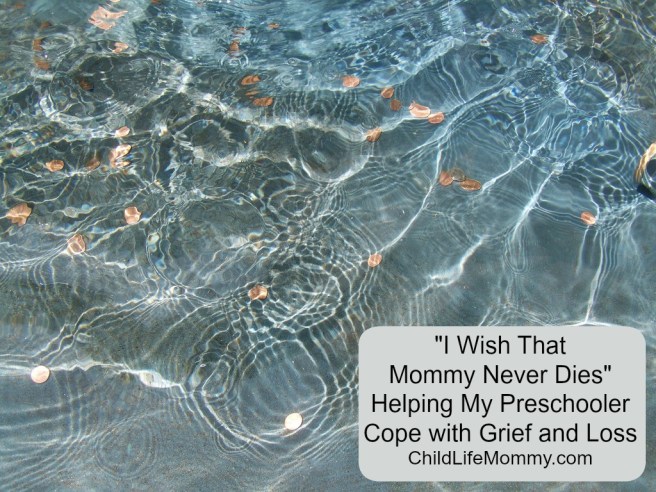
“I Wish That Mommy Never Dies” Helping My Preschooler Cope with Grief and Loss

Childlifemommy hits the nail on the head with how to support young children coping with death. Empathy and expressive open-ended play leads a path to healing.

Child Life Mommy's avatarChild Life Mommy

"I Wish That Mommy Never Dies" Helping My Preschooler Cope with Grief and Loss.jpg

Whilevisiting family during Christmas break, we decided to grab a bite to eat. I saw a fountain that would be a great distraction for my impatient 4 and a half-year old, while we waited to be seated.As I handed my son pennies to toss into the water,I had no idea that he would have such a powerful wish.

“I wish that Mommy never dies.”

His words took my breath away, as I just stoodthere with a handful of copperpennies that were meant for garbage trucks, police cars and Legos.

Our family had experienced 4 deaths in just a short ten months and my son was realizing the permanence of these deaths.

As a child life specialist that works to support children’s grief, I was witnessing my own son’s emotional torture of understanding death, coping with his fear of loss and trying to understand why his French Bulldog couldn’t come back…

View original post 588 more words

Child Life in the Community: Fiddlehead Care Farm

img_5613

Guest Blogger: Breanne Mathers from Fiddlehead Care Farm

As an inpatient CCLS focused on Brain Injury and Complex Continuing Care, I worked for 9 years at Holland Bloorview Kids Rehabilitation Hospital but, in 2015, I found a new home for my child life skills outside the hospital walls. My business partner, Stephanie Deaken, a registered social worker, and I opened Fiddlehead Care Farm (FCF) in Ontario, Canada. FCF is a 50 acre fully accessible organic farm which provides innovative therapy for children, youth, and young adults with special needs to help them reach their potential and become their best selves. The programs are targeted at improving children’s physical, spiritual, psychosocial and mental health.

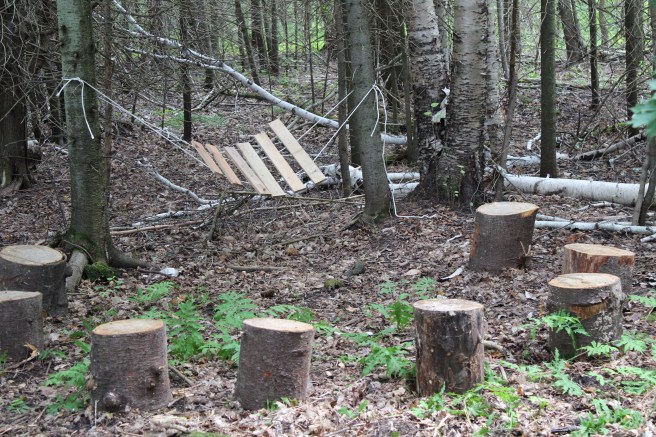
FCF’s mission is to give kids and their families the opportunity to learn, experience and grow without boundaries through animal-assisted therapy and nature-based education, rehabilitation and recreation. We aim to harness the healing and calming properties of nature to improve quality of life and restore the mind, body and spirit.

img_5703

Continue reading

Holiday Cheer Amidst Hard Times

10487385225423713349


I have been a bit silent as a blogger over this past month. I have a list of To Do’s regarding topics I want to get to, but my mojo isn’t flowing.  It could be the general busyness of this time of year – more work to do as I wind up the semester as an educator. More social events in the form of holiday parties and get togethers. More errands to run, more planning and preparation to do for guests arriving from afar (No not the Three Kings!).  It could be due to the need to be present for the many plot twists affecting myself, family and friends lately. Health issues put a crimp in my creativity wiring, whether they are mine or those of a loved one.

But despite the hustle and bustle and items added to my plate, I have been making time every day to enjoy the spirit of the holidays. It is the simple stuff really – taking a moment to enjoy the Christmas lights in the city – having holiday tea with a dear friend –  buying a gingerbread house in an old time bakery in Brooklyn – enjoying a rare treat of fattening eggnog  –  inhaling that wonderful pine scent as I walk past sidewalk Christmas Tree vendors  –  Stopping to hear a high school brass band play Silver Bells on East 86th Street on the longest day of the year –  Watching holiday movies on TV and attending a college production of a favorite Christmas opera Amahl and the Night Visitors. Continue reading

DIY Fingerprint Mold

Our Guest Blogger, Teresa Schoell, is a Certified Child Life Specialist working with pediatric patients and their families in the hospital. She will be sharing a creative way to provide therapeutic…

Source: DIY Fingerprint Mold

The Ripple Effects of Mindfulness and Meditation

Remaining calm and centered during the holidays

Child Life Mommy's avatarChild Life Mommy

The Ripple Effects of Mindfulness and Meditation-2.jpg

I recently completed a six-week course of mindfulness and meditation at my children’s  pediatric wellness center. I went into it with some knowledge of the practice and the benefits that it can bring to people, but not really knowing how to incorporate it fully into my life. My ultimate goal was to deepen my learning experience and to also teach it to my family and the children that I work with in my  practice.

The workshop was led by Cory Muscara from the Long Island Center for Mindfulness.  He was incredibly helpful on breaking down the theory, how to practice different types of meditation and how to realistically weave it into your life. He gave us daily homework to practice guided meditation, self-reflect and increase our awareness of the present moment.

All three may sound easy to do, but it was a challenge because our brains are wired to constantly…

View original post 280 more words

Preventing Pediatric Pain: A Longterm Win Win


imgres

Amy Baxter, MD, the queen bee of pediatric pain prevention

“I believe established medicine is courting a public health disaster, not because of costs or lawsuits or one dumb publication from a scientist gone bad, but because of a national Pavlovian failure of empathy.” — Amy Baxter

Who is Amy?

“Emergency pediatrician Amy Baxter noticed a disconnect in health care: caregivers often cause pain to solve a problem, but for many patients, pain is the problem. While researching the causes and consequences of untreated pain, she invented Buzzy, a bee-shaped device that physiologically takes the sting out of shots using high frequency vibrations and cold. Amy is the director of Emergency Research for Pediatric Emergency Medicine Associates at Children’s Healthcare of Atlanta, Scottish Rite. In the academic world, she is known for creating and validating the BARF nausea scale for children, and an algorithm to measure the timing of child abuse. Honors include a 2011 Medical Design Excellence Award, Georgia Bio Innovative CEO of the Year, and a Wall Street Journal “Idea Person.”” (TEDMED, retrieved November 7, 2016)

In a recent conversation with Dr. Baxter, I asked her about her war on pain, and her appreciation for the field of Child Life.

What are your beliefs about pediatric pain and the need to prevent it?

I take seriously the oath to First Do No Harm.  When iatrogenic procedural pain causes people to fear healthcare later in life, we have done harm.  When we withhold pain management in the trauma bay, we do harm. I have always been suspicious when we do something without pain management to someone small enough to hold down, but we sedate or give analgesics when they’re big enough to fight back.

What do you believe children need most in the medical setting? 

Children need to know they’re safe.  Therefore, parents need to know we’re doing everything we can to make them not hurt.  Something may happen that isn’t comfortable, but kids need to trust that they’ll be warned.  If there isn’t any way to make it more comfortable, they need to know that their care team and parents are all agreeing and supporting what is best for the child. Even very young children know crap happens; what is scary is when the people who keep their world stable are visibly angry, confused or afraid.  Pain isn’t the worst thing that happens, it’s pain when their parents seem unable to protect them. When I fix a nursemaid’s elbow or a patella, I offer analgesics, but let parent and child know I can make them feel better FAST right now but it is going to be uncomfortable for 5 seconds or less.  Or they can wait, but it will still be a little uncomfortable.  Most opt for fast, but that control and honestly let them know I’m thinking about not hurting them first and foremost.

Why is pain prevention important for very young children?

Kids who are persistently afraid of needles have healthcare consequences. They grow up to be adults who don’t get flu shots, or start insulin when they need it, or donate blood.

What motivates you in uphill battles with sensitizing other medical professionals to the necessity of pain control for infants and children? 

I really believe that truth carries its own coercion.  If people who want to heal see the truth of the importance of pain relief, they eventually will align their behaviors with that belief.  No one wants to be an outlier in medicine.  Once one person sees the truth, that pain relief matters, they can’t unsee that.  Eventually the obvious will become apparent to everyone – we can make the entire system work better when we don’t hurt children.

How did you learn about Child Life?

I know this is hard to believe, but I can’t remember not knowing about Child Life.  I’m sure we didn’t have Child Life in pediatrics when I was training, but perhaps because it always seemed such an obvious need when I first began seeing Child Life specialists, perhaps I assumed they always been someplace, just perhaps not in my department.  I carried distraction toys on my stethoscope and in pockets since I began training, it just seemed logical.  My oldest was born my first year of residency, so I had a natural connection to what worked for different ages from the beginning of my training.

Resources for doctors, parents, nurses, and child life specialists

In this TEDMED Talk, Amy speaks to the increase in vaccinations in early childhood, and the impact it has in increasing needle fears later in life.  Visit her  Buzzy website to find out more about the most cost effective way to prevent needle pain in infants and children.
buzzy-child-life-halloween